
10
min read
BY
Bryan
Bowyer
Why Heterogeneous AI Inference Clusters Don't Work (Yet)
Heterogenous hardware should be deployed everywhere, but it is blocked by software
Introduction
The promise is tantalizing: a heterogeneous AI inference cluster that delivers flexibility, cost efficiency, and resilience by matching each workload to optimal hardware. This lets you deploy models on purpose-built inference accelerators where they shine, fall back to GPUs when needed, and achieve dramatic improvements in power consumption and cost. However, production inference clusters are almost always homogeneous and there is a reason why.
The Hardware Diversity Explosion Is Here
The fact is that GPUs are not optimal for inference. NVIDIA's licensing of Groq technology, custom AI accelerators from every major cloud provider, and dozens of AI hardware startups all point to the same conclusion. Purpose-built inference hardware delivers better performance, lower power, and superior cost efficiency compared to GPUs.
Yet organizations face a paradox. They've invested massively in GPU infrastructure they can't abandon, while knowing specialized hardware could dramatically reduce costs and power consumption. The rational path is to build heterogeneous clusters where new accelerators work alongside existing GPUs, intelligently routing each model to the best-fit Hardware.
So why isn't this happening?
The Blocker Isn't Hardware — It's Software
Heterogeneous AI inference clusters fail at the software layer, not the hardware layer. A production model isn't just weights. It's a complete software stack: model source code, kernel implementations, compiler integration, and runtime dependencies. When you deploy a model on NVIDIA hardware, you're creating a deeply integrated software deployment tied to CUDA kernels, NVIDIA's compiler, and NVIDIA's runtime.
A model deployed on NVIDIA GPUs is fundamentally different from one targeting AWS Inferentia, AMD GPUs, or any of the emerging inference accelerators. You can't simply move traffic between them. What appears to be a heterogeneous cluster collapses into multiple isolated, homogeneous deployments sharing physical infrastructure.
Vendor Fragmentation Creates Deployment Silos
Most AI accelerators require vendor-specific kernels, compilers, and runtimes. This fragmentation creates hard boundaries. You can't freely move models between platforms because the entire software stack must be rebuilt for each target.The switching costs are punishing: complete recompilation, extensive kernel retuning, and thorough revalidation. Critically, you don't know if you'll achieve cost or performance gains until after this expensive redeployment is complete. This drives teams to stick with known hardware rather than gamble on uncertain outcomes.
Even within a single vendor, mixing hardware generations can introduce friction. Kernels tuned for one GPU architecture may hit performance cliffs on the next. Rather than being able to embrace incremental heterogeneity, teams are often forced to upgrade entire clusters in bulk.
Day-0 Model Support Is a Hard Gate
Frontier LLM models move fast and hardware supporting them often doesn't. When a new model drops, only a subset of hardware can run it immediately, typically NVIDIA or AMD GPUs with mature ecosystems. If a new inference accelerator can't support the latest models on day zero, it's excluded from production by default. Hardware companies invest enormous resources building better chips, but without reliable day-0 model support, they can't participate in heterogeneous deployments. They're forced to compete for complete infrastructure replacement which is a far riskier proposition for customers.
Hardware Vendors: You're Solving the Wrong Problem
For the numerous AI accelerator companies in the market: Stop forcing everyone else to learn your proprietary kernel language in order to use your hardware. We understand that you need proprietary tools to bring up your hardware, tune software, and optimize the less complex kernels. That is necessary for development.
But it doesn't scale. You can't ask customers to build complex kernels in your proprietary language just to get sophisticated models running at decent performance. And when your potential customers push that work back onto you, that doesn't scale either. Your engineering team becomes the bottleneck for every deployment.
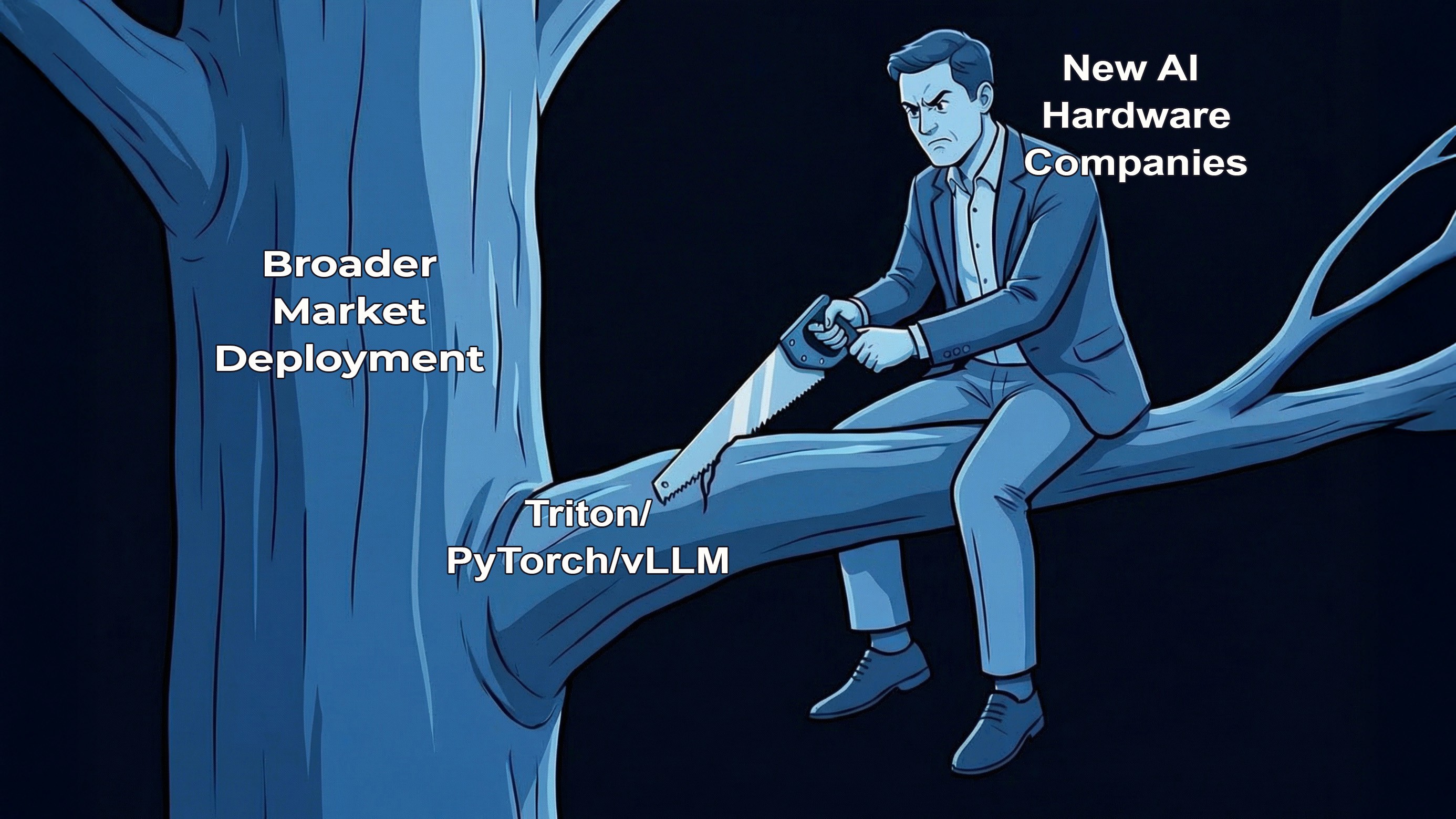
The industry doesn't need another kernel DSL for an additional 2-5% performance. The fragmentation is unsustainable and prevents customer adoption. Your potential customers have billions invested in GPU infrastructure. They won't replace it for unproven alternatives, no matter how impressive your benchmarks. But they'd eagerly add your hardware if it could coexist with existing investments, especially if they could incrementally prove your value while managing risk.You're competing on "our chip is 20% faster" when you should compete on "our chip integrates seamlessly." This enables them to validate your claims and deploy with minimal risk.
The Answer Already Exists
The solution exists today with open-source Triton and the new Triton Extensions. Triton provides a common kernel language that targets diverse hardware architectures predictably and efficiently. It's architecturally sound, has momentum, and provides the portable foundation for true heterogeneous deployment.
Triton has another critical advantage: it's deeply embedded in the PyTorch and vLLM ecosystem that's become the de facto standard for LLM development and deployment. These tools work together, evolve together, and are proven at scale. Building yet another complete stack with a new language, a new runtime and new everything, just fragments the ecosystem further when we need consolidation.
The value and capabilities of Triton are not just theoretical. They are in production at scale right now. What's missing is collective recognition that consolidating around Triton, rather than fragmenting into dozens of proprietary DSLs, is the path forward.
To all hardware vendors, your competitive advantage should be your hardware and not software lock-in. You should build excellent compiler backends that extract great performance from your chips and then embrace Triton to scale your adoption. Your customers will adopt faster and deploy more confidently when you reduce their risk through interoperability.
Hardware Diversity Is Only Increasing
The proliferation of AI accelerators will continue accelerating. Economic pressures, power consumption concerns, and performance requirements guarantee it. Every major cloud provider is building custom silicon. Dozens of startups are bringing innovative architectures to market. The question isn't whether inference hardware will diversify; it's whether that diversity will be deployable or merely theoretical.
The industry needs to deploy models without locking them to a single device or hardware generation. But none of this is possible without a portable kernel language as the missing Foundation.
In the next post, we'll explore why portable kernel languages are the critical infrastructure layer that makes heterogeneous inference possible and why Triton is architected to be that foundation.This is Part 1 of a series on building production-ready heterogeneous AI inference clusters. Follow along as we explore the technical foundations that make true hardware diversity achievable.