
3
min read
BY
Bryan
Bowyer
Turning Triton into a Truly Portable Language
Announcing Triton Extensions and Kernelize
Introduction
We recently shared on LinkedIn that the Triton community is moving toward a more flexible, extensible kernel ecosystem through Triton Extensions. Today we’re making that announcement part of our blog so it has a permanent home and so we can start a conversation that continues here week by week.
Over the past year, specialized AI hardware has moved from an interesting niche to a mainstream consideration for inference infrastructure. CPUs and GPUs still do a lot of heavy lifting, but custom inference architectures are now part of every hardware roadmap. This shift has exposed a gap: software that can adapt quickly and reliably across a wide range of devices is still catching up.
Why Portability Matters
The core of this gap isn’t about silicon capability. Modern AI models are pushing the boundaries of what hardware and compilers were originally designed for. Each new architecture brings its own instructions, memory hierarchy, and performance trade-offs. Without a shared kernel language, teams are forced to build and maintain separate, custom backends and hand-tuned libraries that are expensive and slow to evolve.
That’s why Triton’s approach, a simple, tile-based kernel language grounded in open-source principles, has resonated so broadly. Triton gives developers a way to describe compute that is both expressive and performance-oriented, without being locked to CUDA or a another vendor’s software stack. It’s already moved beyond its origins because the community saw a need for something that just worked on more devices. For example, Triton is used extensively in the new vLLM V1 engine.
What Triton Extensions Enable
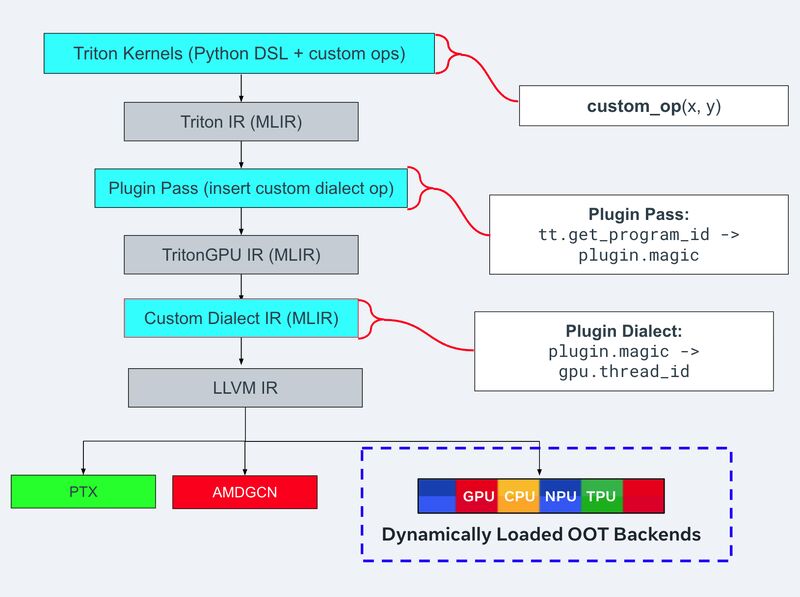
Triton Extensions formalize how people can build on Triton without forking it. They make it possible to add new operations, compiler passes, or backend integrations in a way that stays upstream compatible. In practice, that means hardware companies don’t have to recreate and maintain a their own compiler ecosystem just to support their device, and model developers don’t have to rewrite kernels every time they target something new.
Extensions reduce fragmentation while preserving flexibility. They create a path for Triton to be a portable kernel language, not just a better way to write CUDA-like code.
What We’re Doing with Kernelize
At Kernelize, we’re focused on supporting this transition. Our work is about helping Triton run consistently and efficiently across a wider range of hardware, while staying closely aligned with the mainline ecosystem.
Our goal isn’t to build another proprietary layer on top of Triton. It’s to help the community unlock new hardware without creating silos of software. When hardware vendors, compiler teams, and model developers share a common foundation, it becomes possible to support the latest models faster, with fewer surprises.
What’s Next
This blog post marks the start of a series where we’ll explore what portable kernels mean in practice:
How Triton Extensions change the way kernels are written and shared
What it takes to integrate new backends without fragmenting the ecosystem
How compiler and hardware communities can collaborate without trade-offs
What portability looks like for inference infrastructure in 2026 and beyond
We are also inviting voices from across the community to share real lessons from implementation and deployment.
If you’re working on AI inference hardware, compiler backends, or tooling built around Triton, we’d love to hear from you.